Hi - If you look closely you’ll see that this is just a mixer, not a controller. Other than the built-in dual-USB sound card, there aren’t any software controls.
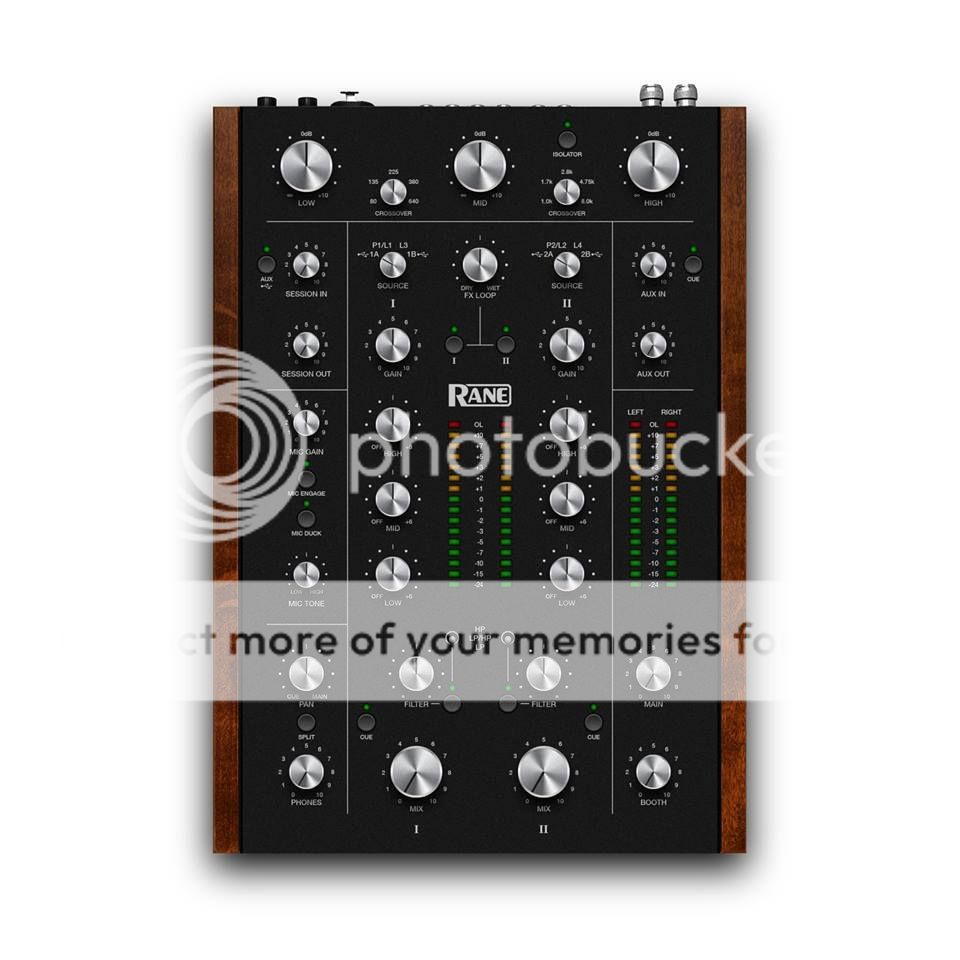
Can’t speak for all rotary users of course, but as a longtime user of them myself (Bozak, Urei, E&S) I’m very excited and curious about what Rane is doing with the MP2105 (and hopefully a smaller 2-channel variant as concept rendering shows above). Here’s why: Just like with digital photography, advancements in digital audio has had quantum leaps in recent years to the point digital photography is now able to faithfully reproduce what could once only be achieved with film and a darkroom. I’m cautiously optimistic that Rane has done their homework and spared no expense in that department with the MP2015 (as they claim to have during its introduction).
Will the MP2015 have the same kind of unicorn magic sound that a DJR 400 has? I have no idea yet since I haven’t even seen a MP2015 yet much less heard one. It could sound like crap for all I know, or it could blow me away. I do find it kind of humorous though that there are some who are poopooing the MP2015’s audio performance without ever hearing one yet either.
In additional to vinyl, I’m also a Serato DJ user for playback of uncompressed digital material, so the idea of having a hot rod rotary mixer that I can run in a setup that two DJs can saddle up to via dual-USBs without need for an external interface is very appealing for a lot of gig scenarios. Not only would it eliminate the need to carry extra gear, RCA cabling, and wiring it all up and all the inherent hassle that come along for the ride with that, it would also eliminate the additional conversion of D to A in the external interface, and then back to D to A yet again in the mixer. Staying 100% digital up until the mixer spits it out analog eliminates all that.
Will a rotary mixer with built-in sound card like the MP2015 or the concept above replace me running say a Condesa or SuperStereo DN78 Phantom Valve mixer? No, absolutely not, at least not entirely for all situations, but it will definitely be favored for some situations, assuming of course the sound performance is up to snuff. Different tools for different applications, and different grooves for different moods is all.
Why? Digital audio surpassed analog a long time ago in terms of purely accurate reproduction. For me, it’s about the human-device interface. Relatively tight knobs just work better.
The simplicity isn’t there, though. And that’s a pity. But, well, I guess they have to make sacrifices to appeal to a wider audience.
I’ve never understood the militant analog argument at all (after I knew enough to not blindly trust people who say vinyl sounds better). The only valid one I’ve heard is that for some releases the master that gets pressed to vinyl is different from the one that gets released in digital formats and one may be better than the other.
That’s totally valid.
It’s also different for every release and completely independent of the medium. The Bernie Grundman mastered vinyl copy of Metallica S&M sounds better than the original CD release…because it was mastered by Bernie Grundman and he knows what he’s doing (even if he does a lot of irrelevant things as well).
But, yeah…I really don’t get why going Fruity Loops → Mastering Engineer → wav → Vinyl is supposed to sound better than Fruity Loops → Mastering Engineer → wav. It doesn’t make any sense as long as the label releases the better master in both cases.
The real question is why one or the other is allowed to sound worse.
I had the interesting experience of going to a nice hifi showroom a couple weeks ago. I can now say that I’ve heard a $60,000 stereo (McIntosh preamp and monoblocks and B&W 800D2 speakers).
We were using a CD as the source.
It was an amazing experience.
It would have been better if they’d put a grand into even basic room treatments.
Quality analog DJ mixers have sounded better imo up until the Xone DB series which sound amazing with vinyl. Good pre-amps with quality digital sampling A/D conversion sounds amazing at reproducing audio though some people like the ‘sound signature’ of analog gear. It’s a similar story with analog synths, you can get crystal clear accurate sound with digital gear and even good emulations of analog warmth or grit, but the real thing in in some cases has imperfections, or a more unpredictable variation in sound that seems hard for a computer process to emulate. It’s the same as analog film, it adds character that some people prefer for certain applications.

 than a poorly mastered vinyl any day of the week… and I love vinyl.