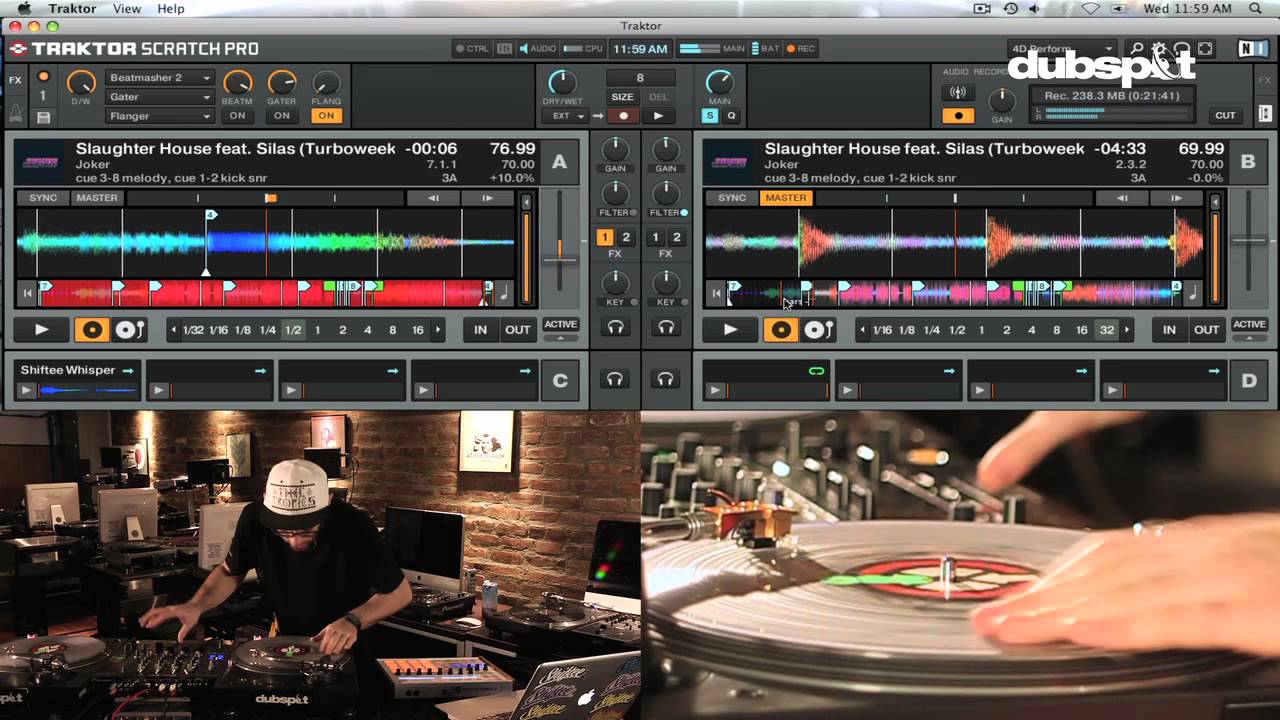
Programs like Traktor Pro, Itch or Scratch Live, Torq and Virtual DJ are all great apps and they have all been pushing to become the “Best of the Best” in Digital DJing, which apparently means “offering a good product but also more bells and whistles than than the other guys” when it comes to music control (a.k.a. more than just two turntables and a microphone… which apparently, is “Where it’s at”… thank you, Beck).
If you’ve picked up a DJ program and a controller, you’ve probably heard about a really advanced controller or seen “sidecar hardware” that can do a bunch of neat things in addition to your standard controller needs (see “Where it’s at” comment above).
So yeah… Serato has formed a “Survivor-like” alliance with Ableton to make “the Bridge” but is it worth it? Could a person do just as well with a good controller and Maschine? How about the Red-Headed stepchild no one speaks about, Torq 2.0; it has a lot of what Bridge offers how does this rate?
If you’ve been looking at hardware to control the software you too have probably been doing this and getting a headache trying to put the pieces together in your head (or even on paper). I happen to have a MacBook Pro and a Twitch playing on either Traktor or Itch. Sometimes I think “Wow, I could buy another $500 worth of Hardware and get ready for Bridge (via Itch and that Lite version of Ableton Live that comes with the Launchpad or APC 40) or I could get a Maschine and go that route… or even get the Steinberg CMC piece-meal controllers to add on to what I have already ?”
Can we get at least a hardware-with-software jamboree round-up of these attempts into crossing the divide between DJ and Producer, a place many might call “Controllerism Land?”
I am interested in The One software as well, that we still have not seen reviewed as of yet.
Regarding your Twitch, it integrates like magic with Itch (correct?), but how do you rate it with TP2? I love the idea of the Twitch, so portable and seems really keen on fostering creativity.
The people at Novation really did a great job on this controller. With version 2.1 of Itch, the Samples are triggered with a Shift + Hot Cue function. I’m hoping this becomes a toggle instead of a momentary “on switch” function in the future. Using the Twitch in Traktor Pro 2 seems pretty good, you really have to dig to find areas that aren’t as good as they should be (I really wanted Slicer Mode in Traktor ), but you can remedy almost every problem with the Controller Manager and re-assign things with MIDI mapping. That being said, the Twitch handles everything TP2 can throw at it and says “more please.”
Most people don’t get that there are 4 “Mode buttons” under each touch strip which acts like a “voice bank” for a MIDI Keyboard which effectively makes the 8 buttons below each “side” of the controller into 32 buttons per Deck, multiply that by 4 decks and you’re looking at 128 different trigger buttons (albeit most are already pre-assigned, but you can re-assign buttons in modes you don’t like). In Itch, you can grab a loop and pinch or expand it like you would with an iPhone, making the loop smaller or larger… I’m still trying to implement that mode in Traktor. I can tell you I am really enjoying the (Needle) Drop mode on the touch strip… it’s even better than I remember Vinyl to be. I’ve reassigned the loop buttons to “PLOOP” (as per DJ Shiftee, whom I highly recommend) and I’ve reassigned to sample triggers on deck C and D.
I’ve taken the Twitch to a couple clubs and made real-time mash-ups, glitch and “extended versions” of songs when I saw people really wanted more out of the song I was playing… and it’s kinda’ fun knowing I was the only one able to do that at the club (that night).
I have nothing bad to say about the effects, they’re all good, I just wish there was the option to use 4 at once per side (in Itch), the EQ is great and so is the Filter. Nothing wrong with the up-faders or cross-fader despite other people’s claims that it felt loose or cheap.
You seem to be concentrating on a “Producer/ DJ” type of performance. Have you missed what NI is bringing out with Traktor 2.5? I think they are trying to get exactly that into one hat, uh…ehem…software.
I’m not sure which way is right because they’re both not out yet… at least Bridge isn’t released for Itch yet, and I’ve heard almost nothing regarding Torq’s internal Bridge-like music management.
Even so, I’m really eyeballing the Novation ReMOTE 25 SL MkII and the Launchpad to round out my Controller kit (for Bridge). Some reasons being that I like hardware up-faders for individual (loop) tracks and the ability to assign “ploops” and samples to the keyboard does interest me… the X-Y pad is just a nice bonus.
I know the APC 40 has up-faders and a 5 x 8 row of buttons (which are smaller than the Launchpad’s buttons) and it’s less expensive, but it seems to be a good, solid choice.
Another pressing question: Noting that Native Instruments Maschine is out, how will the F1 measure up?
I prefer Maschine to Ableton for what I want to do. But I could do it with an MPC.
I maintain that I still haven’t seen anything in controllerism land that I’d ever want to do or listen to except for things that could have been done 20 years ago with a pair of turntables and an MPC.
I completely agree with you. Although its about 20 times easier than 20 years ago to fire up your dj kit and play the brand new tunes you bought 5 minutes ago. Thats the only thing the whole “controllerism” has changed.
I actually disagree with you 100%. I just switched from TP2 to SSL with Technics, and OMFG it’s easier. No more beat grids. No more load markers. No more worrying about settings and what’s plugged into a hub and what’s not.
I want to play something, I throw it in iTunes, plug in my SL1, open SSL, and start playing…it’s awesome.
Only thing easier would be throwing a record on a turntable. :eek:
I’m willing to sacrifice that simplicity for the benefits of spending less on music, having set lists recorded for me (after the fact, for mix CDs and what not), spending less on music, having less weight to carry, and having a simpler time with insurance if stuff gets broken*.
(* the insurance thing: “you owe me a 13” MBP and a Mercury Extreme Pro 6G SSD" is a lot simpler than “I think I had these 200 records with me, but they’re all worth different things, and wait…that’s a collection and not covered !?! no it’s not it’s a business thing that I have insurance for…wait, $5/record, what about my original Jamie Principal records…those things are expensive?! Screw you the mp3 only costs $2…it’s not the same thing”).
Anyway…I think controllerism has mad basic DJing harder for a number of reasons.
What it has done is made it a lot cheaper.
I’m convinced OP was a spam bot. That doesn’t mean we can’t have a legitimate discussion.
You only read part of what i said. Read the bit about new tunes. Can’t do that with records.
I open my macbook. Plug in my S2. Play tunes and mix them by ear. No timecode bollocks, no beatgrid crap, no warping. I can take it with me when I’m away for work.
How on earth isn’t that easier than buying records, new carts, new timecode records, storing your real records, having a 2 metre wide space to play with, plugging in serato boxes etc etc?
DJing IS easier these days, not neccesarily better and yes, probably cheaper.
I disagree with the “what you hear from controllerism that is good these days you could do 20 years ago with turntables” statement. Yes, if a controllerist performance is good, you shouldn’t hear anything but a good roll of music, just like you would from a record. However, what is done to put that mix or track together “on the fly” could never ever be done with two turntables. For instance, some of Ean’s performances like the S2 NI demo video could never have been done with two turntables. Never ever. I could come up with a several more examples too.
And those who think controllerism isn’t the future of DJing, is missing the bus completely IMHO, because as soon as the controllerist tools are mastered more and more by the manufacturers and the controllerist DJs themselves and their performances become more of a cool and different dance experience due to the really well “twisted” music, then the guys and gals with just their turntables and CDJs will be wondering why they didn’t catch the controllerist bus. Controllerism is raising the level of the game.
[quote=“oliosky, post:13, topic:37645, username:oliosky”]
You only read part of what i said. Read the bit about new tunes. Can’t do that with records.
[/quote]You mean the part I quoted in my reply or something else? I definitely see what you’re saying, but I’ll see your buying carts and cleaning records and raise you MIDI mapping and metadata.
Basically…I just don’t think that particular argument is all that good in deciding. And, like you (I think) I’ve done it all…vinyl, CDs, DVS, controllers…and I think CDJs are the easiest and best for the way I play…but insanely expensive, so DVS is a good second choice.
We’ve agreed. And hopefully we still respect each other. That’s all that matters.
I’ve seen all of Ean’s videos and listened to more than one recorded live set of his. I’ve never heard anything that would hold a candle to a good, traditional DJ.
Also, bear in mind that I didn’t say 20 years ago with turntables…I said 20 years ago with turntables and an MPC. If you’re going to try to be the first person to argue this point legitimately (I agree, it’s a matter to be argued, not one that’s settled) then you should at least understand my argument first.
I really wish I owned an MPC and were decent at scratching, because everything I’ve seen Ean do is possible on 20-year-old gear. It’s not something that modern technology enables. It’s something that modern technology makes cheaper (in some ways) and easier (in some ways).
And I still think it sounds like unmitigated crap.
Thanks scamo, I know that a lot of people aren’t keen on using a lot of equipment for DJing but those who are interested in using programs and controllers to DJ in this way, they have to spend a lot of money (on hardware at least) just to try them out to see if these things work well for them.
I guess I’m asking for User ratings of how they like combining two (or more) software environments, what could be done better and how people feel their expanded kits satisfy their needs to what is already out there and alternatives to bridging two programs (like the upcoming version 2.5 of Traktor Pro coming in April).
The F1 (specifically, the new sample decks) does different things.
Maschine doesn’t do time-stretching yet (it’s biggest fault), so anything that you can’t split into individual hits only plays right at one tempo. It also takes longer to cut loops. And actually performing the same way would be weird.
They’re different tools, IMHO. One of them appeals to me much more than the other, mostly because I feel like I’d just use Live for everything if I were going to do the types of things that the new Sample Decks will be good at. But if I were going to perform like that, I’d also be using a bigger mixer and doing Live PA stuff with occasional tracks…and I’m not a good enough producer to subject audiences to my tracks at this point.
Plus…I’d probably prefer using hardware if I were going to do that anyway.
I’ll concede this point.
You could do it 20 years ago, but it does take more time to move the needle to a sticker on a record or custom-made dub plate. So, 20 years of advancement saves you about a second (each time you do it) and saves a lot of money from not having to have dub plates cut. Again…probably easier, a lot cheaper.
Congratulations, you’re the first to point something like this out.
The DJM-800 has a pre-converter attenuator on the master. If it’s set to -12dB (for example), the right way to run that mixer without wasting dynamic range is to peak at +12 on the master, which I think corresponds to the “over” light. If I knew that’s where the attenuator was set, I’d aim for peaking at +9.
Anyway, either his attenuator was set to 0dB or he was amplifying the nosie floor in whatever came after the DJM-800. In practice, you want to be peaking close to 0dB at the output, not necessarily at the meter…mostly because cheap FOH mixers are noisier (higher noise floor, lower dynamic range, whatever) than the DJM-800. If you’re running into a Midas or recording into a real system at 24bit, it doesn’t matter that much. I tend to record with a peak of -8dB (post-conversion on the DAW’s meters) and it works great…plenty of room for EQing and light limiting.
So…with this feature, Pioneer allows sound guys to compensate for moronic DJs, and the good ones have to play like morons if they want to sound as good as possible.
I enjoyed running Maschine with Traktor Pro 2. I don’t know what other people were complaining about, the MIDI clock was basically flawless when I used it. I’m willing to bet they just didn’t know what they were doing or they weren’t anal about their beat grids.
I changed away from it because playing that way requires perfect beat grids, and I got sick of setting them. Maschine and hardware groove boxes (like the MPCs or the Octatrack) allow for beat-matching manually, and I already knew how to spin on vinyl. Basically…I wasn’t willing to put in the bitchy, technical prep work anymore, not when beat-matching vinyl is so easy.
I’m debating whether it’s a better use of my time to integrate Maschine with my current setup by running it completely independent and beat-matching it manually as well or whether it’d be worth hosting Maschine in Ableton to use Bridge. I need to know exactly how Bridge functions, and I can’t think of a good way to test that other than upgrading to an SL3/4, which I’ll probably do soon anyway.
I know we’re getting off topic but If someone has the gains in the double red on a channel couldn’t the signal already be clipping and distorted even if the master attenuator is bringing it down at the output since the damage would already be done before the signal reaches it? I’ve seen quite a few people with gains in the double red on DJMs and the club subwoofers sound like they’re dying making horrid noises.
 ), but you can remedy almost every problem with the Controller Manager and re-assign things with MIDI mapping. That being said, the Twitch handles everything TP2 can throw at it and says “more please.”
 Controllerism is raising the level of the game.